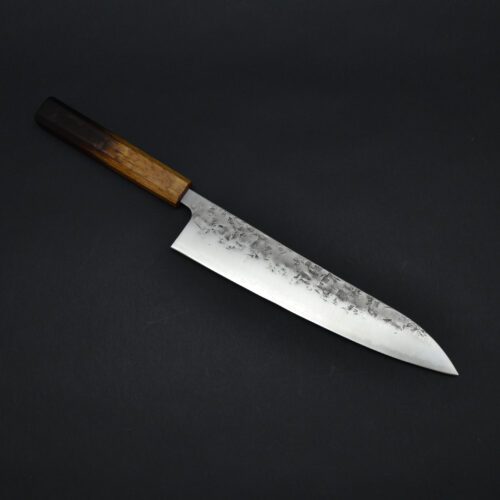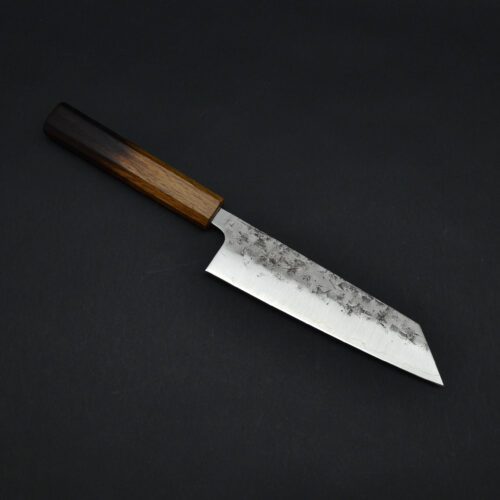
| Brand / Blacksmith: | Hado Fukui |
| Series: | Oul SLD |
| Knife type: | Bunka 170mm |
| Blade Length / Total length (mm): | 170 / 322 |
| Grind: | 50/50 |
| Finish: | Nashiji |
| Steel type: | SLD |
| Forging method: | San Mai |
| HRC hardness: | 61 |
| Handle type / Material / Ferrule: | Wa / Burnt Oak |
| Spine Thickness at heel / tip (mm): | 2 / 0,3 |
| Blade height at heel (mm): | 45 |
| Weight (gr): | 130 |
| Notes: |
-
Hado, which means the road of ‘ha’ (刃, blades). is the brand name for the knives crafted by Fukui Co & Ltd. Japanese artisans attach great importance to ‘tamashi’ (魂, soul). They pour their own souls into individual works. The word, ‘tamashi’ has various contexts. It can mean one’s spirit, determination, backbone, et cetra. ‘Tamashi’ is at the core of Hado project. We sharpen knives one by one, putting our tamashi into the knives. The feeling of the blades builds up something ineffable on our hands and hearts. The OUL SLD series are forged using the exceptional SLD steel at a 62-63 HRC hardness, a steel that sharpens very easily like carbon steel but is much less reactive to rust and feature a nashiji finish. Combined with an beautiful Burnt Oak wa handle, these knives are shouting beauty and tradition. The Bunka is a multi-purpose knife and similar to Nakiri with usually a slightly different nose shape and shorter profile. Recommended mainly for push cut, slice and chopping cutting techniques. The Bunka was developed as an evolution to Nakiri with a more pointed nose for more delicate cuts.
-
Hado, which means the road of ‘ha’ (刃, blades). is the brand name for the knives crafted by Fukui Co & Ltd. Japanese artisans attach great importance to ‘tamashi’ (魂, soul). They pour their own souls into individual works. The word, ‘tamashi’ has various contexts. It can mean one’s spirit, determination, backbone, et cetra. ‘Tamashi’ is at the core of Hado project. We sharpen knives one by one, putting our tamashi into the knives. The feeling of the blades builds up something ineffable on our hands and hearts. The OUL SLD series are forged using the exceptional SLD steel at a 62-63 HRC hardness, a steel that sharpens very easily like carbon steel but is much less reactive to rust and feature a nashiji finish. Combined with an beautiful Burnt Oak wa handle, these knives are shouting beauty and tradition. Meaning “Beef knife” in Japanese, the Gyuto is the most common and basic of all knives, the Japanese version of the classic western Chef’s knife. It is used as a multi-purpose knife, suitable for meat, fish, vegetables and more. Can be used with almost all different cutting techniques. Can be used with almost all different cutting techniques. The 240mm is a commonly used size, handy for both professional and experienced home cooks.
Brand / Blacksmith: Hado Fukui Series: Oul SLD Knife type: Gyuto 240mm Blade Length / Total length (mm): 245 / 430 Grind: 50/50 Finish: Nashiji Steel type: SLD Forging method: San Mai HRC hardness: 61 Handle type / Material / Ferrule: Wa / Burnt Oak Spine Thickness at heel / tip (mm): 2 / 0,3 Blade height at heel (mm): 51 Weight (gr): 170 Notes: -
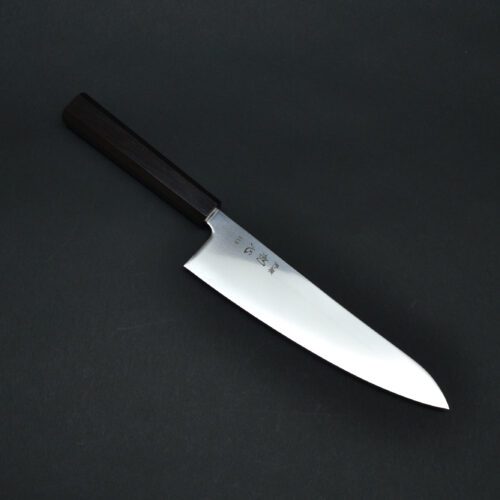
Sale!Hatsu – Kokoro means innocent spirit. A very important wholesaler from Amagasaki city in Hyogo prefecture cooperating with some of the best craftsmen in Japan. The Hatsukokoro brand is their house brand, crafted from undisclosed but some of the most experienced blacksmiths. The Hikari Series are made of new technology SLD SEMI stainless steel that holds an edge for very long but at the same time is easy to sharpen. Polished finish with a distinct lamination line makes it look beautiful combined with a perfect fit and finish and a Mono Ebony octagonal handle. The most impressive characteristic of this series is it’s extreme, laser like, grind and blade thickness as well as it’s light weight! Meaning “Beef knife” in Japanese, the Gyuto is the most common and basic of all knives, the Japanese version of the classic western Chef’s knife. It is used as a multi-purpose knife, suitable for meat, fish, vegetables and more. Can be used with almost all different cutting techniques. The 210mm is a common size, for most professional and home cooks.
Brand / Blacksmith Hatsukokoro Series: Hikari Knife type: Gyuto 210 Blade Length / Total length (mm): 210/350 Grind: 50/50 Finish: Polished / Satin Steel type: SLD Forging method: San Mai HRC hardness: 61 Handle type / Material / Ferrule: Wa / Mono Ebony Spine Thickness at heel / tip (mm): 1,7/0,2 Blade height at heel (mm): 50 Weight (gr): 140 Notes: -
Hatsu – Kokoro means innocent spirit. A very important wholesaler from Amagasaki city in Hyogo prefecture cooperating with some of the best craftsmen in Japan. The Hatsukokoro brand is their house brand, crafted from undisclosed but some of the most experienced blacksmiths. The Hikari Series are made of new technology SLD SEMI stainless steel that holds an edge for very long but at the same time is easy to sharpen. Polished finish with a distinct lamination line makes it look beautiful combined with a perfect fit and finish and a Mono Ebony octagonal handle. The most impressive characteristic of this series is it’s extreme, laser like, grind and blade thickness as well as it’s light weight! With a tall blade and rounded nose, the Santoku is a versatile, all over, knife that is suitable for cutting meat, fish, or vegetables. The name Santoku means “Three-purpose” (virtues). Used mainly with chopping and push cuts. This specific knife can also be used as a tall petty because of its size.
Brand / Blacksmith Hatsukokoro Series: Hikari Knife type: Ko - Santoku 150 Blade Length / Total length (mm): 150 / 275 Grind: 50/50 Finish: Polished / Satin Steel type: SLD Forging method: San Mai HRC hardness: 61 Handle type / Material / Ferrule: Wa / Mono Ebony Spine Thickness at heel / tip (mm): 1,7 / 0,3 Blade height at heel (mm): 38 Weight (gr): 83 Notes: -
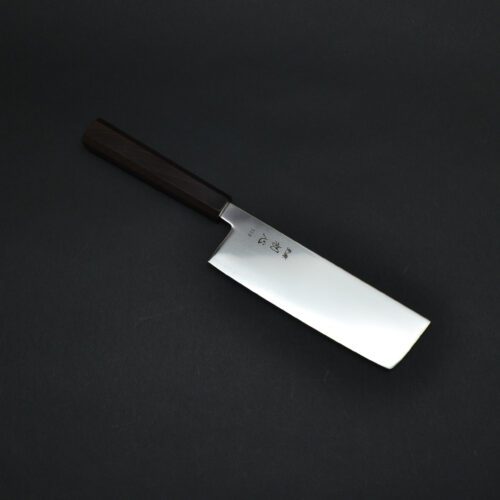
Hatsu – Kokoro means innocent spirit. A very important wholesaler from Amagasaki city in Hyogo prefecture cooperating with some of the best craftsmen in Japan. The Hatsukokoro brand is their house brand, crafted from undisclosed but some of the most experienced blacksmiths. The Hikari Series are made of new technology SLD SEMI stainless steel that holds an edge for very long but at the same time is easy to sharpen. Polished finish with a distinct lamination line makes it look beautiful combined with a perfect fit and finish and a Mono Ebony octagonal handle. The most impressive characteristic of this series is it’s extreme, laser like, grind and blade thickness as well as it’s light weight! The Nakiri, that looks like a small cleaver, is a specialized knife for vegetables. It is a double bevel knife and has a tall, thin blade in order to go through vegetables easily. It is a very popular knife throughout Japan as well as the rest of the world because its specialized profile makes the veggie preparation so easy. Feels nimble in the handle despite its size and its thin blade is designed for precise cuts. Perfect for chopping, slicing and push cuts.
Brand / Blacksmith Hatsukokoro Series: Hikari Knife type: Nakiri 160 Blade Length / Total length (mm): 165 / 305 Grind: 50/51 Finish: Polished / Satin Steel type: SLD Forging method: San Mai HRC hardness: 62 Handle type / Material / Ferrule: Wa / Mono Ebony Spine Thickness at heel / tip (mm): 1,7 / 0,5 Blade height at heel (mm): 52 Weight (gr): 162 Notes: -
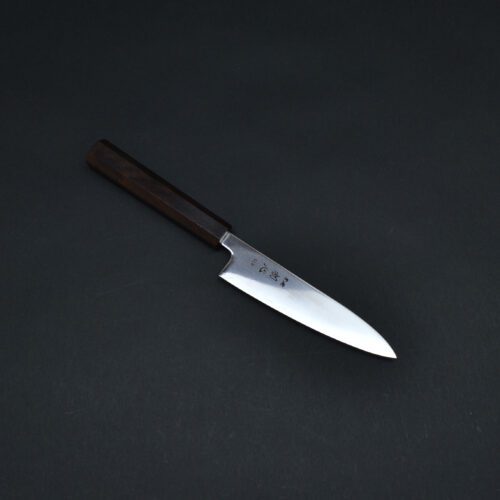
Hatsu – Kokoro means innocent spirit. A very important wholesaler from Amagasaki city in Hyogo prefecture cooperating with some of the best craftsmen in Japan. The Hatsukokoro brand is their house brand, crafted from undisclosed but some of the most experienced blacksmiths. The Hikari Series are made of new technology SLD SEMI stainless steel that holds an edge for very long but at the same time is easy to sharpen. Polished finish with a distinct lamination line makes it look beautiful combined with a perfect fit and finish and a Mono Ebony octagonal handle. The most impressive characteristic of this series is it's extreme, laser like, grind and blade thickness as well as it's light weight! Petty is one of the most commonly used knives in the kitchen. A small, general-purpose knife used for peeling, shaping, and slicing fruits and vegetables, chopping herbs, and making garnishes that also can be used in handheld cuts.
Brand / Blacksmith Hatsukokoro Series: Hikari Knife type: Petty 130 Blade Length / Total length (mm): 130 / 260 Grind: 50/50 Finish: Polished / Satin Steel type: SLD Forging method: San Mai HRC hardness: 61 Handle type / Material / Ferrule: Wa / Mono Ebony Spine Thickness at heel / tip (mm): 1,85 / 0,4 Blade height at heel (mm): 33 Weight (gr): 75 Notes: -
Hatsu – Kokoro means innocent spirit. A very important wholesaler from Amagasaki city in Hyogo prefecture cooperating with some of the best craftsmen in Japan. The Hatsukokoro brand is their house brand, crafted from undisclosed but some of the most experienced blacksmiths. The Hikari Series are made of new technology SLD SEMI stainless steel that holds an edge for very long but at the same time is easy to sharpen. Polished finish with a distinct lamination line makes it look beautiful combined with a perfect fit and finish and a Mono Ebony octagonal handle. The most impressive characteristic of this series is it's extreme, laser like, grind and blade thickness as well as it's light weight! With a tall blade and rounded nose, the Santoku is a versatile, all over, knife that is suitable for cutting meat, fish, or vegetables. The name Santoku means “Three-purpose” (virtues). Used mainly with chopping and push cuts.
Brand / Blacksmith Hatsukokoro Series: Hikari Knife type: Santoku 170 Blade Length / Total length (mm): 170 / 305 Grind: 50/50 Finish: Polished / Satin Steel type: SLD Forging method: San Mai HRC hardness: 61 Handle type / Material / Ferrule: Wa / Mono Ebony Spine Thickness at heel / tip (mm): 1,7 / 0,25 Blade height at heel (mm): 47 Weight (gr): 134 Notes: -
Sale!The founder of Tadafusa, Sone Torasaburo started the company from nothing in the 23rd year of the Showa era in 1948. He made various kinds of knives such as sickles, short swords and kitchen knives by using the forging techniques he learned as an apprentice making hand-forged metal scales. He gradually started to specialize in making fishing knives and then also address a need to create kitchen knives for home and professional use and special knives for Soba up to today. Since the company’s foundation, they strive to create “the best products” for customers by hand through every single process and to make each knife with utmost enthusiasm. The SLD Hammer tone series has one of the most distinctive hammered patterns in Japanese knife making. Each blacksmith has its own Tsuchime pattern. Their Tsuchime is based on geometric diamond pattern, which has been familiar from ancient times in Japan. Hitachi SLD Steel has more chromium than carbon steel such as Blue Paper Steel or White Paper Steel, which means that it is more resistant to rust but not fully stainless (semi stainless). Also, it holds a sharp edge and a long edge retention by its hardness and toughness. It is popular steel for kitchen knives in Japan. Meaning “Beef knife” in Japanese, the Gyuto is the most common and basic of all knives, the Japanese version of the classic western Chef’s knife. It is used as a multi-purpose knife, suitable for meat, fish, vegetables and more. Can be used with almost all different cutting techniques. The 210mm size is the most common, used both by professional and home cooks.
Brand / Blacksmith: Tadafusa Series: SLD Hammer Tone Knife type: Gyuto 210 Blade Length / Total length (mm): 210/360 Grind: 50/50 Finish: Tsuchime / Hammered Steel type: SLD (semi stainless) Forging method: San Mai HRC hardness: 62 - 63 Handle type / Material / Ferrule: Wa Octagonal / Wooden ferule Spine Thickness at heel / tip (mm): 2,2/0,4 Blade height at heel (mm): 48 Weight (gr): 176 Notes: -
The founder of Tadafusa, Sone Torasaburo started the company from nothing in the 23rd year of the Showa era in 1948. He made various kinds of knives such as sickles, short swords and kitchen knives by using the forging techniques he learned as an apprentice making hand-forged metal scales. He gradually started to specialize in making fishing knives and then also address a need to create kitchen knives for home and professional use and special knives for Soba up to today. Since the company’s foundation, they strive to create “the best products” for customers by hand through every single process and to make each knife with utmost enthusiasm. The SLD Hammer tone series has one of the most distinctive hammered patterns in Japanese knife making. Each blacksmith has its own Tsuchime pattern. Their Tsuchime is based on geometric diamond pattern, which has been familiar from ancient times in Japan. Hitachi SLD Steel has more chromium than carbon steel such as Blue Paper Steel or White Paper Steel, which means that it is more resistant to rust but not fully stainless (semi stainless). Also, it holds a sharp edge and a long edge retention by its hardness and toughness. It is popular steel for kitchen knives in Japan. Meaning “Beef knife” in Japanese, the Gyuto is the most common and basic of all knives, the Japanese version of the classic western Chef’s knife. It is used as a multi-purpose knife, suitable for meat, fish, vegetables and more. Can be used with almost all different cutting techniques. The 240mm size is to be used both by professional and experienced home cooks.
Brand / Blacksmith: Tadafusa Series: SLD Hammer Tone Knife type: Gyuto 240 Blade Length / Total length (mm): 240/395 Grind: 50/50 Finish: Tsuchime / Hammered Steel type: SLD (semi stainless) Forging method: San Mai HRC hardness: 62 - 63 Handle type / Material / Ferrule: Wa Octagonal / Wooden ferule Spine Thickness at heel / tip (mm): 2,2/0,4 Blade height at heel (mm): 50 Weight (gr): 206 Notes: -
The founder of Tadafusa, Sone Torasaburo started the company from nothing in the 23rd year of the Showa era in 1948. He made various kinds of knives such as sickles, short swords and kitchen knives by using the forging techniques he learned as an apprentice making hand-forged metal scales. He gradually started to specialize in making fishing knives and then also address a need to create kitchen knives for home and professional use and special knives for Soba up to today. Since the company’s foundation, they strive to create “the best products” for customers by hand through every single process and to make each knife with utmost enthusiasm. The SLD Hammer tone series has one of the most distinctive hammered patterns in Japanese knife making. Each blacksmith has its own Tsuchime pattern. Their Tsuchime is based on geometric diamond pattern, which has been familiar from ancient times in Japan. Hitachi SLD Steel has more chromium than carbon steel such as Blue Paper Steel or White Paper Steel, which means that it is more resistant to rust but not fully stainless (semi stainless). Also, it holds a sharp edge and a long edge retention by its hardness and toughness. It is popular steel for kitchen knives in Japan. The Hiraki or Kaisaki is a special knife that can be used as a shellfish knife or filleting small fish. Can also be used as a small general use knife.
Brand / Blacksmith: Tadafusa Series: SLD Hammer Tone Knife type: Hiraki 165 Blade Length / Total length (mm): 164/320 Grind: 50/50 Finish: Tsuchime / Hammered Steel type: SLD (semi stainless) Forging method: San Mai HRC hardness: 62 - 63 Handle type / Material / Ferrule: Wa Octagonal / Wooden ferule Spine Thickness at heel / tip (mm): 3,4/0,4 Blade height at heel (mm): 38 Weight (gr): 130 Notes: -
The founder of Tadafusa, Sone Torasaburo started the company from nothing in the 23rd year of the Showa era in 1948. He made various kinds of knives such as sickles, short swords and kitchen knives by using the forging techniques he learned as an apprentice making hand-forged metal scales. He gradually started to specialize in making fishing knives and then also address a need to create kitchen knives for home and professional use and special knives for Soba up to today. Since the company’s foundation, they strive to create “the best products” for customers by hand through every single process and to make each knife with utmost enthusiasm. The SLD Hammer tone series has one of the most distinctive hammered patterns in Japanese knife making. Each blacksmith has its own Tsuchime pattern. Their Tsuchime is based on geometric diamond pattern, which has been familiar from ancient times in Japan. Hitachi SLD Steel has more chromium than carbon steel such as Blue Paper Steel or White Paper Steel, which means that it is more resistant to rust but not fully stainless (semi stainless). Also, it holds a sharp edge and a long edge retention by its hardness and toughness. It is popular steel for kitchen knives in Japan. The Honesuki is a rather small knife specifically created for filleting chicken and poultry. It’s the Japanese equivalent to the boning knife with a flatter and higher profile. This design makes it easy to chop through the joints of the chicken (rabbits etc) when you ‘re filleting them. The tip of the knife is usually thin, so it can glide easily through flesh. The heel of the blade is used for hard bits, and the tip is used for articulate slicing. The 150mm is the most common size.
Brand / Blacksmith: Tadafusa Series: SLD Hammer Tone Knife type: Honesuki 150 Blade Length / Total length (mm): 150/290 Grind: 50/50 Finish: Tsuchime / Hammered Steel type: SLD (semi stainless) Forging method: San Mai HRC hardness: 62 - 63 Handle type / Material / Ferrule: Wa Octagonal / Wooden ferule Spine Thickness at heel / tip (mm): 3/0,4 Blade height at heel (mm): 40 Weight (gr): 114 Notes: