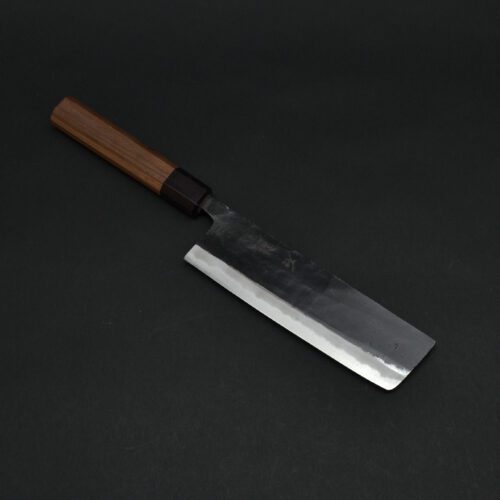
| Brand / Blacksmith: | Hatsukokoro |
| Series: | Shirasagi |
| Knife type: | Deba |
| Blade Length / Total length (mm): | 167 / 315 |
| Grind: | Single Bevel |
| Finish: | Polished |
| Steel type: | White 2 |
| Forging method: | San Mai |
| HRC hardness: | 62 |
| Handle type / Material / Ferrule: | Octagonal / Wenge / Horn |
| Spine Thickness at heel / tip (mm): | 6,7 |
| Blade height at heel (mm): | 52 |
| Weight (gr): | 278 |
| Notes: |
-
Hatsu - Kokoro means innocent spirit. A very important wholesaler from Amagasaki city in Hyogo prefecture cooperating with some of the best craftsmen in Japan. The Hatsukokoro brand is their house brand, crafted from undisclosed but some of the most experienced blacksmiths. This single bevel series, made by Tamura Tooru at Myojin Hamono for Hatsukokoro, is inspired by the Japanese White Egret flower (as its made from White-2 carbon steel). They feature a delicate Migaki (polished) / Satin finish and a beautiful Teak wood Wa octagonal handle. The Deba is a single bevel knife traditionally designed for filleting small and medium size fishes. Nowadays, it is used by many to break down and filleting small poultry too. Its heavy, sturdy structure allows it to easily cut small bones of fish and poultry but is not recommended on larger bones as it may chip. The 165mm size is ideal to be used for filleting medium to large size fish. Important Note: This is a Carbon Steel knife and not a stainless one. Requires attention and care in its maintenance like quick washing and drying after use, storing in low humidity area and application of mineral oil if not used for some time. Over time it will form a patina that will protect it from rust. In case rust appears, use baking soda on wet blade, leave it for 10 mins and rub carefully with your finger or a soft sponge. In case rust is not removed, contact us for further instructions.
-
Founded more than 100 years ago in 1919 by Tokie Hokiyama in Tosa – Shikoku Island – Hokiyama cutlery stands on a triangle of values: Tradition, Innovation and practicality. They preserve the original clad forging method cultivated over 800 years of Tosa cutlery history with craftsman spirit and ambitions of making further innovations for the future. While making traditional knives, they keep on searching up-to-date technologies, materials and manufacturing process, and always trying to develop more refined products aiming at further evolution. The Sakon Ginga series is made of Silver-3 (Gingami) stainless steel and cladded with SUS-405 stainless steel, fitted with a Magnolia traditional Wa handle. The Deba is a single bevel knife traditionally designed for filleting small and medium size fishes. Nowadays, it is used by many to break down and filleting small poultry too. Its heavy, sturdy structure allows it to easily cut small bones of fish and poultry but is not recommended on larger bones as it may chip. The 165mm size is to be used for filleting medium to larger fish. THIS KNIFE IS FOR LEFT HANDED USERS
Brand / Blacksmith: Hokiyama Series: Ginga Knife type: Deba 165 - Left Handed Blade Length / Total length (mm): 170 / 313 Grind: Single Bevel Finish: Polished Steel type: Ginsan Forging method: San Mai HRC hardness: 62 Handle type / Material / Ferrule: Oval / Magnolia / Plastic Spine Thickness at heel / tip (mm): 6,85 Blade height at heel (mm): 53 Weight (gr): 280 Notes: -
Sale!Founded more than 100 years ago in 1919 by Tokie Hokiyama in Tosa – Shikoku Island – Hokiyama cutlery stands on a triangle of values: Tradition, Innovation and practicality. They preserve the original clad forging method cultivated over 800 years of Tosa cutlery history with craftsman spirit and ambitions of making further innovations for the future. While making traditional knives, they keep on searching up-to-date technologies, materials and manufacturing process, and always trying to develop more refined products aiming at further evolution. The Sakon Ginga series is made of Silver-3 (Gingami) stainless steel and cladded with SUS-405 stainless steel, fitted with a Magnolia traditional Wa handle. The Deba is a single bevel knife traditionally designed for filleting small and medium size fishes. Nowadays, it is used by many to break down and filleting small poultry too. Its heavy, sturdy structure allows it to easily cut small bones of fish and poultry but is not recommended on larger bones as it may chip. The 165mm size is to be used for filleting medium to larger fish and is the most common size of all.
-
Founded more than 100 years ago in 1919 by Tokie Hokiyama in Tosa – Shikoku Island – Hokiyama cutlery stands on a triangle of values: Tradition, Innovation and practicality. They preserve the original clad forging method cultivated over 800 years of Tosa cutlery history with craftsman spirit and ambitions of making further innovations for the future. While making traditional knives, they keep on searching up-to-date technologies, materials and manufacturing process, and always trying to develop more refined products aiming at further evolution. The Sakon Ginga line is made of Gingami (Silver-3) stainless steel at a hardness of HRC 61-62. Being also stainless cladded with SUS – 405 stainless steel, requires less care that the carbon steel knives and are very easy to sharpen. Features a beautiful Nashiji finish and an octagonal Rosewood handle. The Nakiri that looks like a small cleaver, is a specialized knife for vegetables. It is a double bevel knife and has a tall, thin blade in order to go through vegetables easily. It is a very popular knife throughout Japan as well as the rest of the world because its specialized profile makes the veggie preparation so easy. Feels nimble in the handle despite its size and its thin blade is designed for precise cuts. Perfect for chopping, slicing and push cuts. Fitted with a beautiful Rosewood Wa octagonal handle.
Brand / Blacksmith: Hokiyama Series: Sakon Ginga Knife type: Nakiri 165mm Blade Length / Total length (mm): 165 / 305 Grind: Double Bevel Finish: Nashiji Steel type: Ginsan (Silver-3) Forging method: San Mai HRC hardness: 62 Handle type / Material / Ferrule: Octagonal / Rosewood / Wood Spine Thickness at heel / tip (mm): 2 Blade height at heel (mm): 51 Weight (gr): 158 Notes: -
Located in Sikoku island in the Ehime prefecture, Ishizuchi started their production exactly 100 years ago, in 1920, lead by Tomika Kajiura as their founder. As many blacksmiths at the time, they first focused in Agricultural tools and equipment. Today, the fourth generation descendants, lead by Taketoshi Kajiura, is focusing exclusively on knives using the area’s craftsmen and striving to deliver high quality traditional knives at competitive prices. The Nakiri that looks like a small cleaver, is a specialized knife for vegetables. It is a double bevel knife and has a tall, thin blade in order to go through vegetables easily. It is a very popular knife throughout Japan as well as the rest of the world because its specialized profile makes the veggie preparation so easy. Feels nimble in the handle despite its size and its thin blade is designed for precise cuts. Perfect for chopping, slicing and push cuts. The Ishizuchi Kurouchi Nakiri 165mm, would be the knife of choice for those who love veggies in their everyday home cooking or professional prep. . It is made from Blue-2 (Aogami 2) steel, one of the most famous steels in Japanese knife making, has a traditional Kurouchi finish and is fitted with a beautiful Walnut handle. This knife is a real bargain for its quality. Important Note: This is a Carbon Steel knife and not a stainless one. Requires attention and care in its maintenance like quick washing and drying after use, storing in low humidity area and application of mineral oil if not used for some time. Over time it will form a patina that will protect it from rust. In case rust appears, use baking soda on wet blade, leave it for 10 mins and rub carefully with your finger or a soft sponge. In case rust is not removed, contact us for further instructions.
Brand / Blacksmith: Ishizuchi Series: Kurouchi Knife type: Nakiri Blade Length / Total length (mm): 165 Grind: 50 / 50 Finish: Kurouchi Steel type: Blue 2 Forging method: San Mai HRC hardness: 62 - 64 Handle type / Material / Ferrule: Octagonal / Rosewood /Plywood Spine Thickness at heel / tip (mm): 2 / 0,6 Blade height at heel (mm): 51 Weight (gr): 146 Notes: -
With a history of over 150 years, Masamoto is one of the best known and preferred brands of traditional Japanese knives in Japan and the most praised and selling among Japanese sushi chefs around the world. The KK series are made with White-2 (Shirogami-2) carbon steel with an impeccable craftsmanship and Kasumi finish. Featuring the traditional Magnolia, D-shaped handle of Masamoto. The Deba is a single bevel knife traditionally designed for filleting small and medium size fishes. Nowadays, it is used by many to break down and filleting small poultry too. Its heavy, sturdy structure allows it to easily cut small bones of fish and poultry but is not recommended on larger bones as it may chip. The 165mm size is ideal to be used for filleting smaller but also larger fish. Important Note: This is a Carbon Steel knife and not a stainless one. Requires attention and care in its maintenance like quick washing and drying after use, storing in low humidity area and application of mineral oil if not used for some time. Over time it will form a patina that will protect it from rust. In case rust appears, use baking soda on wet blade, leave it for 10 mins and rub carefully with your finger or a soft sponge. In case rust is not removed, contact us for further instructions.
Brand / Blacksmith: Masamoto Series: KK Knife type: Deba 165 Blade Length / Total length (mm): 170/315 Grind: Single Bevel Finish: Kasumi Steel type: Shirogami-2 (white-2) Forging method: Ni-Mai HRC hardness: 61 Handle type / Material / Ferrule: D-shaped / Magnolia / Buffalo Horn Spine Thickness at heel / tip (mm): 7,4 Blade height at heel (mm): 53 Weight (gr): 280 Notes: -
Established in 1872 by Mastersmith Torakichi Mizuno in Sakai City in Osaka, Mizuno Tanrenjo became famous for producing the traditional Japanese knives ‘Sakai Uchi’. For 5 generations, the Mizuno family has been recognized as one of the most important family of craftsmen in Japan. A Mayokegama (a sickle to face evil), made by 2nd generation blacksmith Masanori Mizuno, is still decorating the roof of Houryuji temple in Nara, Japan's oldest five story building registered as a National Treasure and the World Heritage monument by UNESCO. Mizuno Tanrenzo workshop is for years the favourite of Japan’s Royal family and has received visits from its members. Today is led by 5th generation blacksmith Jun Mizuno with the precious help of his wife Nanako who is taking care of all non blacksmithing business. Because of his amazing craftsmanship, Jun Mizuno has been appointed by two of Japan’s top shrines who selected his katanas to be in the shrines’ permanent collections. A hand forged series by Master Jun Mizuno, made of Aogami-2 steel with an iron soft cladding. Sharpened by one of the most experienced sharpeners Tsutomu Minamiura, with Kasumi finish and superb thin grinds, overall and behind the edge. Mounted with a beautiful Wa octagonal handle in black Sandalwood with black buffalo horns and copper rings on both ends. The Deba is a single bevel knife traditionally designed for filleting small and medium size fishes. Nowadays, it is used by many to break down and filleting small poultry too. Its heavy, sturdy structure allows it to easily cut small bones of fish and poultry but is not recommended on larger bones as it may chip. The 165mm size is the most common and ideal to be used for filleting medium size fish. Important Note: It is usual that Japanese Handmade knives do not come sharpened at their full potential out of the box. This is due to Japanese mentality that the owner and user should give the final sharpening to his or her knives. This is also the case for Mizuno Tanrenzo knives. If you are not an experienced sharpener, let us give your knife an extra sharpening to reach it’s full potential by clicking on the Extra Sharpening request. This is a Carbon Steel knife and not a stainless one. Requires attention and care in its maintenance like quick washing and drying after use, storing in low humidity area and application of mineral oil if not used for some time. Over time it will form a patina that will protect it from rust. In case rust appears, use baking soda on wet blade, leave it for 10 mins and rub carefully with your finger or a soft sponge. In case rust is not removed, contact us for further instructions.
Brand / Blacksmith: Mizuno Tanrenzo Series: Akitada Knife type: Hon Deba 165 Blade Length / Total length (mm): 170 / 315 Grind: 50/50 Finish: Polished / Kasumi Steel type: Aogami - 2 (Blue - 2) Forging method: San Mai HRC hardness: 62-63 Handle type / Material / Ferrule: Wa / Octagonal / Ebony / Buffalo Spine Thickness at heel / tip (mm): 7,3 Blade height at heel (mm): 53 Weight (gr): 343 Notes: -
One of the top manufacturers in the city of Sakai, known as the “city of knives” that used to be known as the “Venice of the East”. The 600 year continuous tradition, cultivated the Sakai Takayuki brand, making it one of the most famous today in Japan. In 1982 these knives earned the rare distinction to be designated as Traditional Arts and Crafts. A traditional Deba forged with AUS-8 stainless steel that can be considered as an easy to maintain filleting tool. Its size is ideal for medium fish. Features a traditional oval magnolia handle. The Deba is a single bevel knife traditionally designed for filleting small and medium size fishes. Nowadays, it is used by many to break down and filleting small poultry too. Its heavy, sturdy structure allows it to easily cut small bones of fish and poultry but is not recommended on larger bones as it may chip. The 165mm size is ideal to be used for filleting medium but also larger fish.
Brand / Blacksmith: Sakai Takayuki Series: Inox (Wa handle) Knife type: Deba 165 Blade Length / Total length mm: 167 / 312 Grind: Single Bevel Finish: Polished Steel type: AUS-8 (Stainless) Forging method: Monosteel HRC hardness: 60 Handle type / Material / Ferrule: Round / Magnolia / Plastic Spine Thickness at heel / tip mm: 7 Blade height at heel mm: 53 Weight gr: 279 Notes: -
The founder of Tadafusa, Sone Torasaburo started the company from nothing in the 23rd year of the Showa era in 1948. He made various kinds of knives such as sickles, short swords and kitchen knives by using the forging techniques he learned as an apprentice making hand-forged metal scales. He gradually started to specialize in making fishing knives and then also address a need to create kitchen knives for home and professional use and special knives for Soba up to today. Since the company’s foundation, they strive to create “the best products” for customers by hand through every single process and to make each knife with utmost enthusiasm. The SLD Hammer tone series has one of the most distinctive hammered patterns in Japanese knife making. Each blacksmith has its own Tsuchime pattern. Their Tsuchime is based on geometric diamond pattern, which has been familiar from ancient times in Japan. Hitachi SLD Steel has more chromium than carbon steel such as Blue Paper Steel or White Paper Steel, which means that it is more resistant to rust but not fully stainless (semi stainless). Also, it holds a sharp edge and a long edge retention by its hardness and toughness. It is popular steel for kitchen knives in Japan. The Hiraki or Kaisaki is a special knife that can be used as a shellfish knife or filleting small fish. Can also be used as a small general use knife.
Brand / Blacksmith: Tadafusa Series: SLD Hammer Tone Knife type: Hiraki 165 Blade Length / Total length (mm): 164/320 Grind: 50/50 Finish: Tsuchime / Hammered Steel type: SLD (semi stainless) Forging method: San Mai HRC hardness: 62 - 63 Handle type / Material / Ferrule: Wa Octagonal / Wooden ferule Spine Thickness at heel / tip (mm): 3,4/0,4 Blade height at heel (mm): 38 Weight (gr): 130 Notes: -
Sharpener Makoto Tadokoro entered the kitchen knife industry at the age of 16, and after 15 years under the training of the legendary sharpener Morihiro -San in Sakai, launched his own brand "Marushin" Became independent in 2010, establishing Tosa Knife Studio Tadokoro Hamono. As a sharpener for more than 28 years, the skills that have been handed down as a Japanese tradition are highly evaluated in the domestic and overseas markets, and his passion for kitchen knives is unparalleled, so he is highly trusted. Today, he has grown into one of Japan's leading sharpeners, recognized by his masters, top Japanese cutlery craftsmen, and chefs. The Ginsan Series are forged by another Master – Satoshi Nakagawa – then handed to Makoto for his unique 30 steps grinding and sharpening process. The result is Masterpieces!! We have selected the Mirror polished version of the series, that are very rare to acquire but showcase Tadokoro – San amazing skills at its best!! They also come with a beautiful Ebony handle, featuring a polished ring and no ferule. The Deba is a single bevel knife traditionally designed for filleting small and medium size fishes. Nowadays, it is used by many to break down and filleting small poultry too. Its heavy, sturdy structure allows it to easily cut small bones of fish and poultry but is not recommended on larger bones as it may chip. The 165mm size is the most common and ideal to be used for filleting medium size fish.
Important Notes: Some knives may present a small gap between the blade and the handle. This is called Machi and is common in some cases for Japanese knives. As these knives are polished to a mirror finish, they may present minor / light hairline marks as it is common in this type of finish. Buyers should be aware of that fact before purchasing These knives have a protective lacquer for better protection of the blade. That lacquer may blur the mirror finish and will go away with use or can be removed initially with aceton and white spirit using kitchen paper.Brand / Blacksmith: Tadokoro Hamono Series: Ginsan Knife type: Deba 165 Blade Length / Total length mm: 170 / 315 Grind: Single Bevel Finish: Polished / Kasumi Steel type: Ginsan (Silver - 3) Forging method: San Mai HRC hardness: 62 Handle type / Material / Ferrule: Ebony Mono / Silver Ring Spine Thickness at heel / tip mm: 5,8 / 0,7 Blade height at heel mm: 46 Weight gr: 269 Notes: