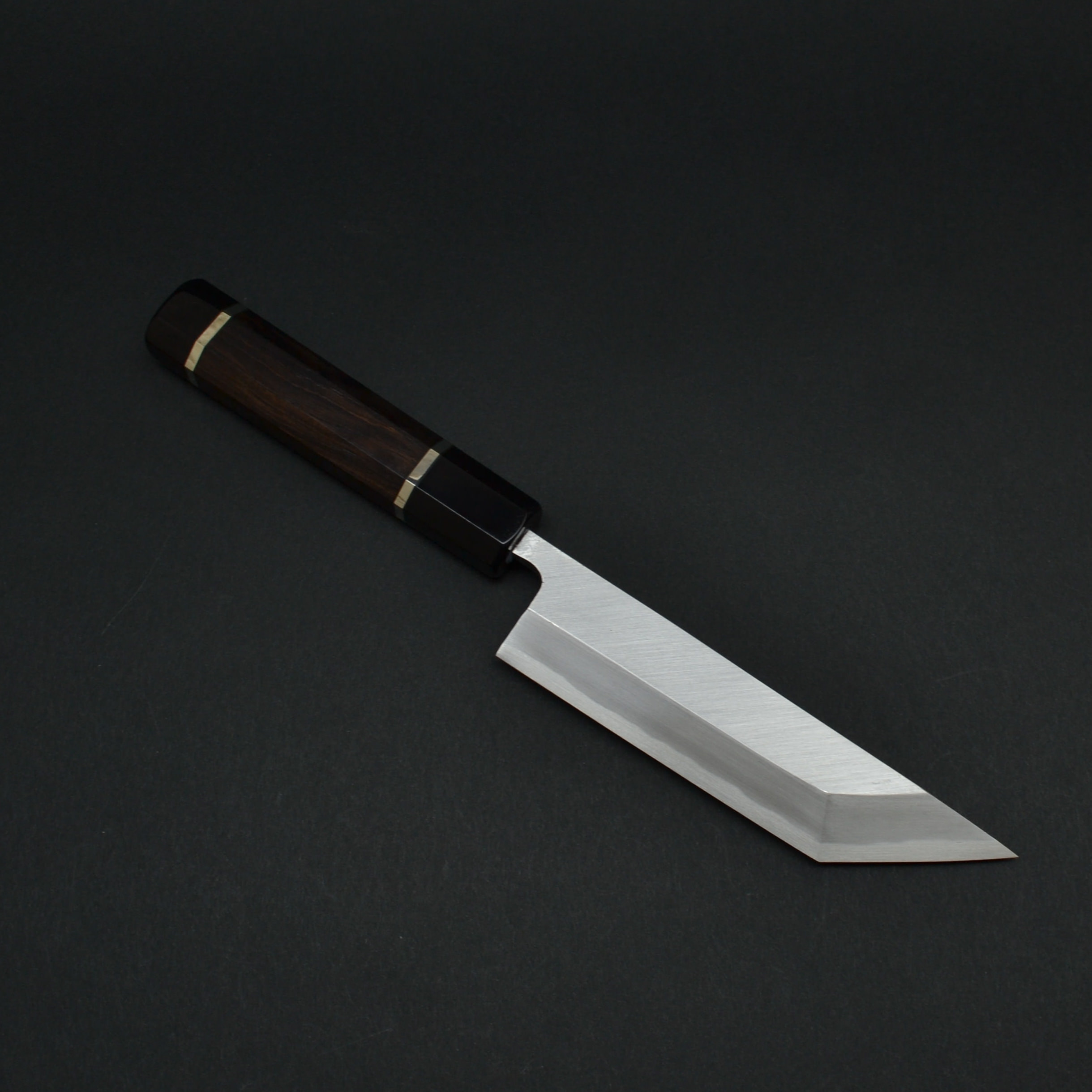
| Brand / Blacksmith: | Hokiyama |
| Series: | Ginga |
| Knife type: | Yanagiba 270mm - Left Handed |
| Blade Length / Total length (mm): | 261 / 413 |
| Grind: | Single Bevel |
| Finish: | Polished |
| Steel type: | Ginsan |
| Forging method: | San Mai |
| HRC hardness: | 62 |
| Handle type / Material / Ferrule: | Oval / Magnolia / Plastic |
| Spine Thickness at heel / tip (mm): | 3,1 / 0,3 |
| Blade height at heel (mm): | 34 |
| Weight (gr): | 165 |
| Notes: |
-
Founded more than 100 years ago in 1919 by Tokie Hokiyama in Tosa – Shikoku Island – Hokiyama cutlery stands on a triangle of values: Tradition, Innovation and practicality. They preserve the original clad forging method cultivated over 800 years of Tosa cutlery history with craftsman spirit and ambitions of making further innovations for the future. While making traditional knives, they keep on searching up-to-date technologies, materials and manufacturing process, and always trying to develop more refined products aiming at further evolution. The Sakon Ginga series is made of Silver-3 (Gingami) stainless steel and cladded with SUS-405 stainless steel, fitted with a Magnolia traditional Wa handle. This is a yanagiba for Left handed users The Yanagiba (meaning willow leaf blade) is the traditional Japanese Sashimi knife. Used mainly to cut thin slices of fish without damaging the cells of the delicate fish protein. It can also be used for meat. The 300mm size is one of the most common for medium to big pieces of fillets.
-
Founded more than 100 years ago in 1919 by Tokie Hokiyama in Tosa – Shikoku Island – Hokiyama cutlery stands on a triangle of values: Tradition, Innovation and practicality. They preserve the original clad forging method cultivated over 800 years of Tosa cutlery history with craftsman spirit and ambitions of making further innovations for the future. While making traditional knives, they keep on searching up-to-date technologies, materials and manufacturing process, and always trying to develop more refined products aiming at further evolution. The Sakon Ginga series is made of Silver-3 (Gingami) stainless steel and cladded with SUS-405 stainless steel, fitted with a Magnolia traditional Wa handle. The Yanagiba (meaning willow leaf blade) is the traditional Japanese Sashimi knife. Used mainly to cut thin slices of fish without damaging the cells of the delicate fish protein. It can also be used for meat. The 300mm size is one of the most common for medium to big pieces of fillets. The 300mm size is used by experienced users to slice larger pieces of fish.
Brand / Blacksmith: Hokiyama Series: Ginga Knife type: Yanagiba 300mm - Right Handed Blade Length / Total length (mm): 290 / 450 Grind: Single Bevel Finish: Polished Steel type: Ginsan Forging method: San Mai HRC hardness: 62 Handle type / Material / Ferrule: Oval / Magnolia / Wood Spine Thickness at heel / tip (mm): 3,5 / 0,4 Blade height at heel (mm): 36 Weight (gr): 205 Notes: -
Founded more than 100 years ago in 1919 by Tokie Hokiyama in Tosa – Shikoku Island – Hokiyama cutlery stands on a triangle of values: Tradition, Innovation and practicality. They preserve the original clad forging method cultivated over 800 years of Tosa cutlery history with craftsman spirit and ambitions of making further innovations for the future. While making traditional knives, they keep on searching up-to-date technologies, materials and manufacturing process, and always trying to develop more refined products aiming at further evolution. The Sakon Shiraume series is made of AUS-8 stainless steel and cladded with SUS-405 stainless steel, fitted with a beautiful Wenge traditional Wa handle. The Ko- Deba is a single bevel knife traditionally designed for filleting small size fishes. Nowadays, it is used by many to break down and filleting small poultry too. Its heavy, sturdy structure allows it to easily cut small bones of fish and poultry but is not recommended on larger bones as it may chip.
-
Sale!The brand name “Kanetsune” was named after a famous sword Smith, Kanetsune who existed in Muromachi period around 14-15 century. He made extremely keen and tough Katanas that were known by many Samurais then in Japan and also overseas. Some of his swords are displayed in the Katana museum in Seki city. Kanetsune is considered one of the largest knife producers in Japan, manufacturing different series of knives under their name but also for other well know knife brands. The G series from Kanetsune are made from Shirogami-3 (White-3) Hitachi carbon steel. The feature a polished finish, a beautiful geometry and a D-Shaped traditional magnolia handle. The Yanagiba (meaning willow leaf blade) is the traditional Japanese Sashimi knife. Used mainly to cut thin slices of fish without damaging the cells of the delicate fish protein. It can also be used for meat. The 270mm size is the most common for medium to big pieces of fillets. Important Note: This is a Carbon Steel knife and not a stainless one. Requires attention and care in its maintenance like quick washing and drying after use, storing in low humidity area and application of mineral oil if not used for some time. Over time it will form a patina that will protect it from rust. In case rust appears, use baking soda on wet blade, leave it for 10 mins and rub carefully with your finger or a soft sponge. In case rust is not removed, contact us for further instructions.
Brand / Blacksmith: Kanetsune Series: G Series Knife type: Yanagiba 270mm Blade Length / Total length (mm): 260 / 415 Grind: Single bevel Finish: Polished (Migaki) Steel type: White-3 (shirogami-3) Forging method: Ni Mai HRC hardness: 60-61 Handle type / Material / Ferrule: Spine Thickness at heel / tip (mm): 4,15 / 0,4 Blade height at heel (mm): 35 Weight (gr): 181 Notes: -
With a history of over 150 years, Masamoto is one of the best known and preferred brands of traditional Japanese knives in Japan and the most praised and selling among Japanese sushi chefs around the world. The KK series are made with White-2 (Shirogami-2) carbon steel with an impeccable craftsmanship and Kasumi finish. Featuring the traditional Magnolia, D-shaped handle of Masamoto. The Deba is a single bevel knife traditionally designed for filleting small and medium size fishes. Nowadays, it is used by many to break down and filleting small poultry too. Its heavy, sturdy structure allows it to easily cut small bones of fish and poultry but is not recommended on larger bones as it may chip. The 165mm size is ideal to be used for filleting smaller but also larger fish. Important Note: This is a Carbon Steel knife and not a stainless one. Requires attention and care in its maintenance like quick washing and drying after use, storing in low humidity area and application of mineral oil if not used for some time. Over time it will form a patina that will protect it from rust. In case rust appears, use baking soda on wet blade, leave it for 10 mins and rub carefully with your finger or a soft sponge. In case rust is not removed, contact us for further instructions.
Brand / Blacksmith: Masamoto Series: KK Knife type: Deba 165 Blade Length / Total length (mm): 170/315 Grind: Single Bevel Finish: Kasumi Steel type: Shirogami-2 (white-2) Forging method: Ni-Mai HRC hardness: 61 Handle type / Material / Ferrule: D-shaped / Magnolia / Buffalo Horn Spine Thickness at heel / tip (mm): 7,4 Blade height at heel (mm): 53 Weight (gr): 280 Notes: -
With a history of over 150 years, Masamoto is one of the best known and preferred brands of traditional Japanese knives in Japan and the most praised and selling among Japanese sushi chefs around the world. The KK series are made with White-2 (Shirogami-2) carbon steel with an impeccable craftsmanship and Kasumi finish. Featuring the traditional Magnolia, D-shaped handle of Masamoto. The Yanagiba (meaning willow leaf blade) is the traditional Japanese Sashimi knife. Used mainly to cut thin slices of fish without damaging the cells of the delicate fish protein. It can also be used for meat. The 270mm size is the most common for medium to big pieces of fillets. Important Note: This is a Carbon Steel knife and not a stainless one. Requires attention and care in its maintenance like quick washing and drying after use, storing in low humidity area and application of mineral oil if not used for some time. Over time it will form a patina that will protect it from rust. In case rust appears, use baking soda on wet blade, leave it for 10 mins and rub carefully with your finger or a soft sponge. In case rust is not removed, contact us for further instructions.
Brand / Blacksmith: Masamoto Series: KK Knife type: Yanagiba 270 Blade Length / Total length (mm): 265/430 Grind: Single Bevel Finish: Kasumi Steel type: Shirogami-2 (white-2) Forging method: Ni-Mai HRC hardness: 61 Handle type / Material / Ferrule: D-shaped / Magnolia / Buffalo Horn Spine Thickness at heel / tip (mm): 4 Blade height at heel (mm): 38 Weight (gr): 189 Notes: -
Established in 1872 by Mastersmith Torakichi Mizuno in Sakai City in Osaka, Mizuno Tanrenjo became famous for producing the traditional Japanese knives ‘Sakai Uchi’. For 5 generations, the Mizuno family has been recognized as one of the most important family of craftsmen in Japan. A Mayokegama (a sickle to face evil), made by 2nd generation blacksmith Masanori Mizuno, is still decorating the roof of Houryuji temple in Nara, Japan's oldest five story building registered as a National Treasure and the World Heritage monument by UNESCO. Mizuno Tanrenzo workshop is for years the favourite of Japan’s Royal family and has received visits from its members. Today is led by 5th generation blacksmith Jun Mizuno with the precious help of his wife Nanako who is taking care of all non blacksmithing business. Because of his amazing craftsmanship, Jun Mizuno has been appointed by two of Japan’s top shrines who selected his katanas to be in the shrines’ permanent collections. A hand forged series by Master Jun Mizuno, made of Aogami-2 steel with an iron soft cladding. Sharpened by one of the most experienced sharpeners Tsutomu Minamiura, with Kasumi finish and superb thin grinds, overall and behind the edge. Mounted with a beautiful Wa octagonal handle in black Sandalwood with black buffalo horns and copper rings on both ends. The Deba is a single bevel knife traditionally designed for filleting small and medium size fishes. Nowadays, it is used by many to break down and filleting small poultry too. Its heavy, sturdy structure allows it to easily cut small bones of fish and poultry but is not recommended on larger bones as it may chip. The 165mm size is the most common and ideal to be used for filleting medium size fish. Important Note: It is usual that Japanese Handmade knives do not come sharpened at their full potential out of the box. This is due to Japanese mentality that the owner and user should give the final sharpening to his or her knives. This is also the case for Mizuno Tanrenzo knives. If you are not an experienced sharpener, let us give your knife an extra sharpening to reach it’s full potential by clicking on the Extra Sharpening request. This is a Carbon Steel knife and not a stainless one. Requires attention and care in its maintenance like quick washing and drying after use, storing in low humidity area and application of mineral oil if not used for some time. Over time it will form a patina that will protect it from rust. In case rust appears, use baking soda on wet blade, leave it for 10 mins and rub carefully with your finger or a soft sponge. In case rust is not removed, contact us for further instructions.
Brand / Blacksmith: Mizuno Tanrenzo Series: Akitada Knife type: Hon Deba 165 Blade Length / Total length (mm): 170 / 315 Grind: 50/50 Finish: Polished / Kasumi Steel type: Aogami - 2 (Blue - 2) Forging method: San Mai HRC hardness: 62-63 Handle type / Material / Ferrule: Wa / Octagonal / Ebony / Buffalo Spine Thickness at heel / tip (mm): 7,3 Blade height at heel (mm): 53 Weight (gr): 343 Notes: -
Established in 1872 by Mastersmith Torakichi Mizuno in Sakai City in Osaka, Mizuno Tanrenzo became famous for producing the traditional Japanese knives ‘Sakai Uchi’. For 5 generations, the Mizuno family has been recognized as one of the most important family of craftsmen in Japan. A Mayokegama (a sickle to face evil), made by 2nd generation blacksmith Masanori Mizuno, is still decorating the roof of Houryuji temple in Nara, Japan's oldest five story building registered as a National Treasure and the World Heritage monument by UNESCO. Mizuno Tanrenzo workshop is for years the favourite of Japan’s Royal family and has received visits from its members. Today is led by 5th generation blacksmith Jun Mizuno with the precious help of his wife Nanako who is taking care of all non blacksmithing business. Because of his amazing craftsmanship, Jun Mizuno has been appointed by two of Japan’s top shrines who selected his katanas to be in the shrines’ permanent collections. A hand forged series by Master Jun Mizuno, made of Aogami-2 steel with an iron soft cladding. Sharpened by one of the most experienced sharpeners Tsutomu Minamiura, with Kasumi finish and superb thin grinds, overall and behind the edge. Mounted with a beautiful Wa octagonal handle in black Sandalwood with black buffalo horns and copper rings on both ends. The Yanagiba (meaning willow leaf blade) is the traditional Japanese Sashimi knife. Used mainly to cut thin slices of fish in one draw, without damaging the cells of the delicate fish protein. It can also be used for meat. The 270mm size is the most common for medium and large pieces of fillets. Important Note: It is usual that Japanese Handmade knives do not come sharpened at their full potential out of the box. This is due to Japanese mentality that the owner and user should give the final sharpening to his or her knives. This is also the case for Mizuno Tanrenzo knives. If you are not an experienced sharpener, let us give your knife an extra sharpening to reach it’s full potential by clicking on the Extra Sharpening request. This is a Carbon Steel knife and not a stainless one. Requires attention and care in its maintenance like quick washing and drying after use, storing in low humidity area and application of mineral oil if not used for some time. Over time it will form a patina that will protect it from rust. In case rust appears, use baking soda on wet blade, leave it for 10 mins and rub carefully with your finger or a soft sponge. In case rust is not removed, contact us for further instructions.
Brand / Blacksmith: Mizuno Tanrenzo Series: Akitada Knife type: Yanagiba 270 Blade Length / Total length (mm): 261 / 420 Grind: 50/50 Finish: Polished / Kasumi Steel type: Aogami - 2 (Blue - 2) Forging method: San Mai HRC hardness: 62-63 Handle type / Material / Ferrule: Wa / Octagonal / Ebony / Buffalo Spine Thickness at heel / tip (mm): 3,2 Blade height at heel (mm): 34 Weight (gr): 215 Notes: -
Established in 1872 by Mastersmith Torakichi Mizuno in Sakai City in Osaka, Mizuno Tanrenjo became famous for producing the traditional Japanese knives ‘Sakai Uchi’. For 5 generations, the Mizuno family has been recognized as one of the most important family of craftsmen in Japan. A Mayokegama (a sickle to face evil), made by 2nd generation blacksmith Masanori Mizuno, is still decorating the roof of Houryuji temple in Nara, Japan's oldest five story building registered as a National Treasure and the World Heritage monument by UNESCO. Mizuno Tanrenzo workshop is for years the favourite of Japan’s Royal family and has received visits from its members. Today is led by 5th generation blacksmith Jun Mizuno with the precious help of his wife Nanako who is taking care of all non blacksmithing business. Because of his amazing craftsmanship, Jun Mizuno has been appointed by two of Japan’s top shrines who selected his katanas to be in the shrines’ permanent collections. A hand forged series by Master Jun Mizuno, made of Aogami-2 steel with an iron soft cladding. Sharpened by one of the most experienced sharpeners Tsutomu Minamiura, with Kasumi finish and superb thin grinds, overall and behind the edge. Mounted with a beautiful Wa octagonal handle in black Sandalwood with black buffalo horns and copper rings on both ends. The Edo Saki is a knife specialized for filleting and slicing eels. Is the same as Unagi Saki but in Edo style. Eels are very slippery and delicate fish that require attention to detail in order to be served and presented in the most beautiful way in Unagi Nigiri or Unadon dishes. Important Note: It is usual that Japanese Handmade knives do not come sharpened at their full potential out of the box. This is due to Japanese mentality that the owner and user should give the final sharpening to his or her knives. This is also the case for Mizuno Tanrenzo knives. If you are not an experienced sharpener, let us give your knife an extra sharpening to reach it’s full potential by clicking on the Extra Sharpening request. This is a Carbon Steel knife and not a stainless one. Requires attention and care in its maintenance like quick washing and drying after use, storing in low humidity area and application of mineral oil if not used for some time. Over time it will form a patina that will protect it from rust. In case rust appears, use baking soda on wet blade, leave it for 10 mins and rub carefully with your finger or a soft sponge. In case rust is not removed, contact us for further instructions.
Brand / Blacksmith: Mizuno Tanrenzo Series: Akitada Knife type: Edo Saki Blade Length / Total length (mm): 156 / 295 Grind: 50/50 Finish: Polished / Kasumi Steel type: Aogami - 2 (Blue - 2) Forging method: San Mai HRC hardness: 62-63 Handle type / Material / Ferrule: Wa / Octagonal / Ebony / Buffalo Spine Thickness at heel / tip (mm): 4,9 Blade height at heel (mm): 36 Weight (gr): 206 Notes: -
Established in 1872 by Mastersmith Torakichi Mizuno in Sakai City in Osaka, Mizuno Tanrenzo became famous for producing the traditional Japanese knives ‘Sakai Uchi’. For 5 generations, the Mizuno family has been recognized as one of the most important family of craftsmen in Japan. A Mayokegama (a sickle to face evil), made by 2nd generation blacksmith Masanori Mizuno, is still decorating the roof of Houryuji temple in Nara, Japan's oldest five story building registered as a National Treasure and the World Heritage monument by UNESCO. Mizuno Tanrenzo workshop is for years the favourite of Japan’s Royal family and has received visits from its members. Today is led by 5th generation blacksmith Jun Mizuno with the precious help of his wife Nanako who is taking care of all non blacksmithing business. Because of his amazing craftsmanship, Jun Mizuno has been appointed by two of Japan’s top shrines who selected his katanas to be in the shrines’ permanent collections. This series is hand forged and sharpened in Ginsan (Silver-3) stainless steel, one of the purest stainless Japanese steels. It is often compared with Shirogami and praised because of it long lasting edge retention and ease of sharpening. Kasumi finish and a beautiful black Sandalwood with black buffalo horns and copper rings on both ends handle. The Yanagiba (meaning willow leaf blade) is the traditional Japanese Sashimi knife. Used mainly to cut thin slices of fish in one draw, without damaging the cells of the delicate fish protein. It can also be used for meat. The 270mm size is the most common for medium and large pieces of fillets. Important Note: It is usual that Japanese Handmade knives do not come sharpened at their full potential out of the box. This is due to Japanese mentality that the owner and user should give the final sharpening to his or her knives. This is also the case for Mizuno Tanrenzo knives. If you are not an experienced sharpener, let us give your knife an extra sharpening to reach it’s full potential by clicking on the Extra Sharpening request.
Brand / Blacksmith: Mizuno Tanrenzo Series: Ginsan Knife type: Yanagiba 270 Blade Length / Total length (mm): 263 / 414 Grind: 50/50 Finish: Polished / Kasumi Steel type: Ginsan Forging method: San Mai HRC hardness: 61-62 Handle type / Material / Ferrule: Wa / Octagonal / Ebony / Buffalo Spine Thickness at heel / tip (mm): 4 Blade height at heel (mm): 34 Weight (gr): 219 Notes: -
Sakai knives have been evolving for the last 600 years. Sakai Kikumori (Kawamura Hamono) is considered as one of the most prestigious manufacturers collaborating with some of the legends in the area of Sakai like blacksmiths Yoshikazu Tanaka, Shiraki and top Japanese sharpener Morihiro. These kind of top cooperations go back to 1925 when the company Kawamura Hamono started. The trusted craftsmen at Sakai Kikumori have combined superlative ease of use and beauty in these knives. They are the jewels of Sakai forged blades and embody the highest realization of the Japanese knife. We are very proud to introduce the CHOYO knives series forged by Yoshikazu Tanaka and grinded by Morihiro which feature a gleaming mirror finish that is not only beautiful, but also rust resistant. A very pure steel is used for the cutting edge of the knife. Our CHOYO knives are made using Yasugi Specialty Steel Silver-3 (Ginsan), a high-grade cutlery steel that has inherited the traditions of Japanese steel and is perfectly suited for making knives. A selected magnolia traditional handle adds to the overall beauty of these. The Yanagiba (meaning willow leaf blade) is the traditional Japanese Sashimi knife. Used mainly to cut thin slices of fish without damaging the cells of the delicate fish protein. It can also be used for meat. The 270mm size is the most common for medium to big pieces of fillets. The Kiritsuke version features a K-Tip for precise cuts when needed.
Brand / Blacksmith Sakai Kikumori Series Choyo Knife type Kiritsuke Yanagiba 270mm Blade Length / Total length mm 252 / 415 Grind 50/50 Finish Mirror polish Steel type Ginsan (Silver-3) Forging method San Mai HRC hardness 62 - 63 Handle type / Material / Ferrule Wa / Octagonal / Magnolia / Buffalo Horn Spine Thickness at heel / tip mm 3,8 / 0,2 Blade height at heel mm 34 Weight gr 175 Notes -
Sakai knives have been evolving for the last 600 years. Sakai Kikumori (Kawamura Hamono) is considered as one of the most prestigious manufacturers collaborating with some of the legends in the area of Sakai like blacksmiths Yoshikazu Tanaka, Shiraki and top Japanese sharpener Morihiro. These kind of top cooperations go back to 1925 when the company Kawamura Hamono started. The trusted craftsmen at Sakai Kikumori have combined superlative ease of use and beauty in these knives. They are the jewels of Sakai forged blades and embody the highest realization of the Japanese knife. We are very proud to introduce the CHOYO knives series forged by Yoshikazu Tanaka and grinded by Morihiro which feature a gleaming mirror finish that is not only beautiful, but also rust resistant. A very pure steel is used for the cutting edge of the knife. Our CHOYO knives are made using Yasugi Specialty Steel Silver-3 (Ginsan), a high-grade cutlery steel that has inherited the traditions of Japanese steel and is perfectly suited for making knives. A selected magnolia traditional handle adds to the overall beauty of these. The Yanagiba (meaning willow leaf blade) is the traditional Japanese Sashimi knife. Used mainly to cut thin slices of fish without damaging the cells of the delicate fish protein. It can also be used for meat. The 270mm size is the most common for medium to big pieces of fillets.
Brand / Blacksmith Sakai Kikumori Series Choyo Knife type Yangiba 270mm Blade Length / Total length mm 255 / 415 Grind single bevel Finish Mirror polish Steel type Ginsan (Silver-3) Forging method San Mai HRC hardness 62 - 63 Handle type / Material / Ferrule Wa / Octagonal / Magnolia / Buffalo Horn Spine Thickness at heel / tip mm 3,9 / 0,2 Blade height at heel mm 34 Weight gr 172 Notes