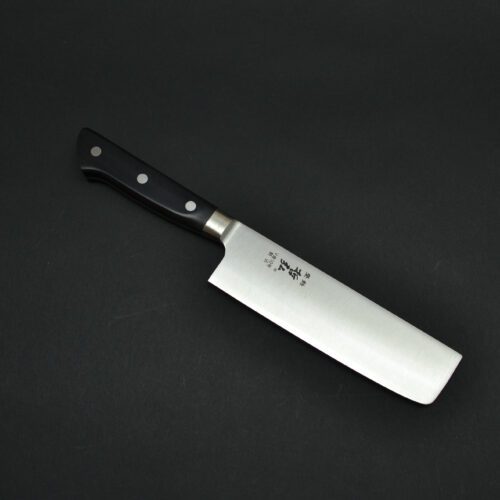
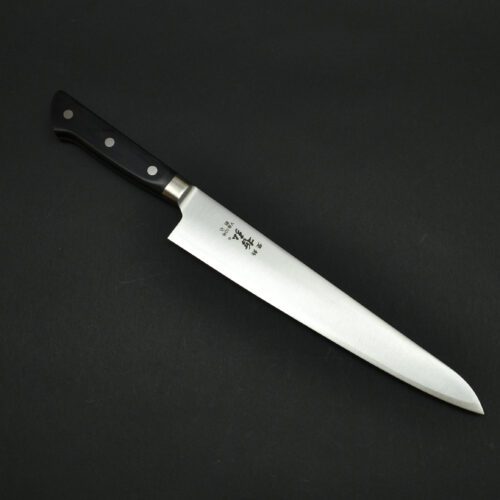
| Brand / Blacksmith: | Tadafusa |
| Series: | SLD Hammer Tone |
| Knife type: | Gyuto 240 |
| Blade Length / Total length (mm): | 240/395 |
| Grind: | 50/50 |
| Finish: | Tsuchime / Hammered |
| Steel type: | SLD (semi stainless) |
| Forging method: | San Mai |
| HRC hardness: | 62 - 63 |
| Handle type / Material / Ferrule: | Wa Octagonal / Wooden ferule |
| Spine Thickness at heel / tip (mm): | 2,2/0,4 |
| Blade height at heel (mm): | 50 |
| Weight (gr): | 206 |
| Notes: |
-
The founder of Tadafusa, Sone Torasaburo started the company from nothing in the 23rd year of the Showa era in 1948. He made various kinds of knives such as sickles, short swords and kitchen knives by using the forging techniques he learned as an apprentice making hand-forged metal scales. He gradually started to specialize in making fishing knives and then also address a need to create kitchen knives for home and professional use and special knives for Soba up to today. Since the company’s foundation, they strive to create “the best products” for customers by hand through every single process and to make each knife with utmost enthusiasm. The SLD Hammer tone series has one of the most distinctive hammered patterns in Japanese knife making. Each blacksmith has its own Tsuchime pattern. Their Tsuchime is based on geometric diamond pattern, which has been familiar from ancient times in Japan. Hitachi SLD Steel has more chromium than carbon steel such as Blue Paper Steel or White Paper Steel, which means that it is more resistant to rust but not fully stainless (semi stainless). Also, it holds a sharp edge and a long edge retention by its hardness and toughness. It is popular steel for kitchen knives in Japan. Meaning “Beef knife” in Japanese, the Gyuto is the most common and basic of all knives, the Japanese version of the classic western Chef’s knife. It is used as a multi-purpose knife, suitable for meat, fish, vegetables and more. Can be used with almost all different cutting techniques. The 240mm size is to be used both by professional and experienced home cooks.
-
The founder of Tadafusa, Sone Torasaburo started the company from nothing in the 23rd year of the Showa era in 1948. He made various kinds of knives such as sickles, short swords and kitchen knives by using the forging techniques he learned as an apprentice making hand-forged metal scales. He gradually started to specialize in making fishing knives and then also address a need to create kitchen knives for home and professional use and special knives for Soba up to today. Since the company’s foundation, they strive to create “the best products” for customers by hand through every single process and to make each knife with utmost enthusiasm. The SLD Hammer tone series has one of the most distinctive hammered patterns in Japanese knife making. Each blacksmith has its own Tsuchime pattern. Their Tsuchime is based on geometric diamond pattern, which has been familiar from ancient times in Japan. Hitachi SLD Steel has more chromium than carbon steel such as Blue Paper Steel or White Paper Steel, which means that it is more resistant to rust but not fully stainless (semi stainless). Also, it holds a sharp edge and a long edge retention by its hardness and toughness. It is popular steel for kitchen knives in Japan. The Hiraki or Kaisaki is a special knife that can be used as a shellfish knife or filleting small fish. Can also be used as a small general use knife.
Brand / Blacksmith: Tadafusa Series: SLD Hammer Tone Knife type: Hiraki 165 Blade Length / Total length (mm): 164/320 Grind: 50/50 Finish: Tsuchime / Hammered Steel type: SLD (semi stainless) Forging method: San Mai HRC hardness: 62 - 63 Handle type / Material / Ferrule: Wa Octagonal / Wooden ferule Spine Thickness at heel / tip (mm): 3,4/0,4 Blade height at heel (mm): 38 Weight (gr): 130 Notes: -
The founder of Tadafusa, Sone Torasaburo started the company from nothing in the 23rd year of the Showa era in 1948. He made various kinds of knives such as sickles, short swords and kitchen knives by using the forging techniques he learned as an apprentice making hand-forged metal scales. He gradually started to specialize in making fishing knives and then also address a need to create kitchen knives for home and professional use and special knives for Soba up to today. Since the company’s foundation, they strive to create “the best products” for customers by hand through every single process and to make each knife with utmost enthusiasm. The SLD Hammer tone series has one of the most distinctive hammered patterns in Japanese knife making. Each blacksmith has its own Tsuchime pattern. Their Tsuchime is based on geometric diamond pattern, which has been familiar from ancient times in Japan. Hitachi SLD Steel has more chromium than carbon steel such as Blue Paper Steel or White Paper Steel, which means that it is more resistant to rust but not fully stainless (semi stainless). Also, it holds a sharp edge and a long edge retention by its hardness and toughness. It is popular steel for kitchen knives in Japan. The Honesuki is a rather small knife specifically created for filleting chicken and poultry. It’s the Japanese equivalent to the boning knife with a flatter and higher profile. This design makes it easy to chop through the joints of the chicken (rabbits etc) when you ‘re filleting them. The tip of the knife is usually thin, so it can glide easily through flesh. The heel of the blade is used for hard bits, and the tip is used for articulate slicing. The 150mm is the most common size.
Brand / Blacksmith: Tadafusa Series: SLD Hammer Tone Knife type: Honesuki 150 Blade Length / Total length (mm): 150/290 Grind: 50/50 Finish: Tsuchime / Hammered Steel type: SLD (semi stainless) Forging method: San Mai HRC hardness: 62 - 63 Handle type / Material / Ferrule: Wa Octagonal / Wooden ferule Spine Thickness at heel / tip (mm): 3/0,4 Blade height at heel (mm): 40 Weight (gr): 114 Notes: -
The founder of Tadafusa, Sone Torasaburo started the company from nothing in the 23rd year of the Showa era in 1948. He made various kinds of knives such as sickles, short swords and kitchen knives by using the forging techniques he learned as an apprentice making hand-forged metal scales. He gradually started to specialize in making fishing knives and then also address a need to create kitchen knives for home and professional use and special knives for Soba up to today. Since the company’s foundation, they strive to create “the best products” for customers by hand through every single process and to make each knife with utmost enthusiasm. The SLD Hammer tone series has one of the most distinctive hammered patterns in Japanese knife making. Each blacksmith has its own Tsuchime pattern. Their Tsuchime is based on geometric diamond pattern, which has been familiar from ancient times in Japan. Hitachi SLD Steel has more chromium than carbon steel such as Blue Paper Steel or White Paper Steel, which means that it is more resistant to rust but not fully stainless (semi stainless). Also, it holds a sharp edge and a long edge retention by its hardness and toughness. It is popular steel for kitchen knives in Japan. The Nakiri, that looks like a small cleaver, is a specialized knife for vegetables. It is a double bevel knife and has a tall, thin blade in order to go through vegetables easily. It is a very popular knife throughout Japan as well as the rest of the world because its specialized profile makes the veggie preparation so easy. Feels nimble in the handle despite its size and its thin blade is designed for precise cuts. Perfect for chopping, slicing and push cuts.
Brand / Blacksmith: Tadafusa Series: SLD Hammer Tone Knife type: Nakiri 165 Blade Length / Total length (mm): 167/310 Grind: 50/50 Finish: Tsuchime / Hammered Steel type: SLD (semi stainless) Forging method: San Mai HRC hardness: 62 - 63 Handle type / Material / Ferrule: Wa Octagonal / Wooden ferule Spine Thickness at heel / tip (mm): 2,2 Blade height at heel (mm): 50 Weight (gr): 165 Notes: -
Sharpener Makoto Tadokoro entered the kitchen knife industry at the age of 16, and after 15 years under the training of the legendary sharpener Morihiro -San in Sakai, launched his own brand "Marushin" Became independent in 2010, establishing Tosa Knife Studio Tadokoro Hamono. As a sharpener for more than 28 years, the skills that have been handed down as a Japanese tradition are highly evaluated in the domestic and overseas markets, and his passion for kitchen knives is unparalleled, so he is highly trusted. Today, he has grown into one of Japan's leading sharpeners, recognized by his masters, top Japanese cutlery craftsmen, and chefs. The Ginsan Series are forged by another Master – Satoshi Nakagawa – then handed to Makoto for his unique 30 steps grinding and sharpening process. The result is Masterpieces!! We have selected the Mirror polished version of the series, that are very rare to acquire but showcase Tadokoro – San amazing skills at its best!! They also come with a beautiful Ebony handle, featuring a polished ring and no ferule. Meaning “Beef knife” in Japanese, the Gyuto is the most common and basic of all knives, the Japanese version of the classic western Chef’s knife. It is used as a multi-purpose knife, suitable for meat, fish, vegetables and more. Can be used with almost all different cutting techniques. The 210mm is the most commonly used size, handy for both professional and home cooks.
Important Notes: Some knives may present a small gap between the blade and the handle. This is called Machi and is common in some cases for Japanese knives. As these knives are polished to a mirror finish, they may present minor / light hairline marks as it is common in this type of finish. Buyers should be aware of that fact before purchasing These knives have a protective lacquer for better protection of the blade. That lacquer may blur the mirror finish and will go away with use or can be removed initially with aceton and white spirit using kitchen paper.Brand / Blacksmith: Tadokoro Hamono Series: Ginsan Knife type: Gyuto 210 Blade Length / Total length mm: 200 / 343 Grind: 50 / 50 Finish: Mirror / Kasumi Steel type: Ginsan (Silver - 3) Forging method: San Mai HRC hardness: 62 Handle type / Material / Ferrule: Ebony Mono / Silver Ring Spine Thickness at heel / tip mm: 2,3 / 0,35 Blade height at heel mm: 48 Weight gr: 194 Notes: -
Sharpener Makoto Tadokoro entered the kitchen knife industry at the age of 16, and after 15 years under the training of the legendary sharpener Morihiro -San in Sakai, launched his own brand "Marushin" Became independent in 2010, establishing Tosa Knife Studio Tadokoro Hamono. As a sharpener for more than 28 years, the skills that have been handed down as a Japanese tradition are highly evaluated in the domestic and overseas markets, and his passion for kitchen knives is unparalleled, so he is highly trusted. Today, he has grown into one of Japan's leading sharpeners, recognized by his masters, top Japanese cutlery craftsmen, and chefs. The Ginsan Series are forged by another Master – Satoshi Nakagawa – then handed to Makoto for his unique 30 steps grinding and sharpening process. The result is Masterpieces!! We have selected the Mirror polished version of the series, that are very rare to acquire but showcase Tadokoro – San amazing skills at its best!! They also come with a beautiful Ebony handle, featuring a polished ring and no ferule. The Kiritsuke is a hybrid knife, similar to a Gyuto but with a K-Tip suitable for delicate tasks and ideal for push cutting technique. It is a knife that is used as a multi-purpose knife, suitable for a wide range of tasks. Is shaped for cutting the vast majority of meats, fishes, vegetables and fruits. Can be also used as a slicer alternative to Sujihiki. The 240mm size is suitable for both experienced home cooks and professionals.
Important Notes: Some knives may present a small gap between the blade and the handle. This is called Machi and is common in some cases for Japanese knives. As these knives are polished to a mirror finish, they may present minor / light hairline marks as it is common in this type of finish. Buyers should be aware of that fact before purchasing These knives have a protective lacquer for better protection of the blade. That lacquer may blur the mirror finish and will go away with use or can be removed initially with aceton and white spirit using kitchen paper.Brand / Blacksmith: Tadokoro Hamono Series: Ginsan Knife type: Kiritsuke 240 Blade Length / Total length mm: 226 / 384 Grind: 50 / 50 Finish: Mirror / Kasumi Steel type: Ginsan (Silver - 3) Forging method: San Mai HRC hardness: 62 Handle type / Material / Ferrule: Ebony Mono / Silver Ring Spine Thickness at heel / tip mm: 2,5 / 0,2 Blade height at heel mm: 45 Weight gr: 222 Notes: -
Tetsuhiro knives was founded in 1945 in Sanjo area by Tetsuo Kiryu, a long time disciple of Yoshiyo Knife. He started specializing in traditional single bevel knives and soon became one very respected brand in the Sanjo area – one of the most famous knife producing regions. With the stainless steels introduced in the Japanese knife making, they made a big investment on machinery and they managed to produce exceptional knives at a larger scale. That gave them the possibility to make exceptional knives at competitive prices. Today Tetsuhiro is known as one of the biggest producers of stainless steel, hand finished knives in Japan. The VG-10 series, have as their core steel the famous VG-10 stainless steel and a softer SUS cladding. They feature a satin / polished finish and an ergonomical western handle. Meaning “Beef knife” in Japanese, the Gyuto is the most common and basic of all knives, the Japanese version of the classic western Chef’s knife. It is used as a multi-purpose knife, suitable for meat, fish, vegetables and more. Can be used with almost all different cutting techniques. The 175mm is a size, handy for both ladies and home cooks.
Brand / Blacksmith: Tetsuhiro Series: VG-10 Knife type: Gyuto 175 Blade Length / Total length (mm): 175 / 300 Grind: 50/50 Finish: Satin Polished Steel type: VG-10 Forging method: San Mai HRC hardness: 61 Handle type / Material / Ferrule: Western / Micarta Black Spine Thickness at heel / tip (mm): 1,8 / 0,3 Blade height at heel (mm): 45 Weight (gr): 164 Notes: -
Tetsuhiro knives was founded in 1945 in Sanjo area by Tetsuo Kiryu, a long time disciple of Yoshiyo Knife. He started specializing in traditional single bevel knives and soon became one very respected brand in the Sanjo area – one of the most famous knife producing regions. With the stainless steels introduced in the Japanese knife making, they made a big investment on machinery and they managed to produce exceptional knives at a larger scale. That gave them the possibility to make exceptional knives at competitive prices. Today Tetsuhiro is known as one of the biggest producers of stainless steel, hand finished knives in Japan. The VG-10 series, have as their core steel the famous VG-10 stainless steel and a softer SUS cladding. They feature a satin / polished finish and an ergonomical western handle. Meaning “Beef knife” in Japanese, the Gyuto is the most common and basic of all knives, the Japanese version of the classic western Chef’s knife. It is used as a multi-purpose knife, suitable for meat, fish, vegetables and more. Can be used with almost all different cutting techniques. The 210mm is the most commonly used size, handy for both professional and home cooks.
Brand / Blacksmith: Tetsuhiro Series: VG-10 Knife type: Gyuto 210 Blade Length / Total length (mm): 211 / 338 Grind: 50/50 Finish: Satin Polished Steel type: VG-10 Forging method: San Mai HRC hardness: 61 Handle type / Material / Ferrule: Western / Micarta Black Spine Thickness at heel / tip (mm): 1,8 / 0,3 Blade height at heel (mm): 46 Weight (gr): 183 Notes: -
Tetsuhiro knives was founded in 1945 in Sanjo area by Tetsuo Kiryu, a long time disciple of Yoshiyo Knife. He started specializing in traditional single bevel knives and soon became one very respected brand in the Sanjo area – one of the most famous knife producing regions. With the stainless steels introduced in the Japanese knife making, they made a big investment on machinery and they managed to produce exceptional knives at a larger scale. That gave them the possibility to make exceptional knives at competitive prices. Today Tetsuhiro is known as one of the biggest producers of stainless steel, hand finished knives in Japan. The VG-10 series, have as their core steel the famous VG-10 stainless steel and a softer SUS cladding. They feature a satin / polished finish and an ergonomical western handle. Meaning “Beef knife” in Japanese, the Gyuto is the most common and basic of all knives, the Japanese version of the classic western Chef’s knife. It is used as a multi-purpose knife, suitable for meat, fish, vegetables and more. Can be used with almost all different cutting techniques. The 240mm is a commonly used size, handy for both professional and experienced home cooks.
Brand / Blacksmith: Tetsuhiro Series: VG-10 Knife type: Gyuto 240 Blade Length / Total length (mm): 242 / 370 Grind: 50/50 Finish: Satin Polished Steel type: VG-10 Forging method: San Mai HRC hardness: 61 Handle type / Material / Ferrule: Western / Micarta Black Spine Thickness at heel / tip (mm): 2,10 / 0,3 Blade height at heel (mm): 50 Weight (gr): 252 Notes: -
Tetsuhiro knives was founded in 1945 in Sanjo area by Tetsuo Kiryu, a long time disciple of Yoshiyo Knife. He started specializing in traditional single bevel knives and soon became one very respected brand in the Sanjo area – one of the most famous knife producing regions. With the stainless steels introduced in the Japanese knife making, they made a big investment on machinery and they managed to produce exceptional knives at a larger scale. That gave them the possibility to make exceptional knives at competitive prices. Today Tetsuhiro is known as one of the biggest producers of stainless steel, hand finished knives in Japan. The VG-10 series, have as their core steel the famous VG-10 stainless steel and a softer SUS cladding. They feature a satin / polished finish and an ergonomical western handle. The Nakiri, that looks like a small cleaver, is a specialized knife for vegetables. It is a double bevel knife and has a tall, thin blade in order to go through vegetables easily. It is a very popular knife throughout Japan as well as the rest of the world because its specialized profile makes the veggie preparation so easy. Feels nimble in the handle despite its size and its thin blade is designed for precise cuts. Perfect for chopping, slicing and push cuts.
Brand / Blacksmith: Tetsuhiro Series: VG-10 Knife type: Nakiri 160 Blade Length / Total length (mm): 160 / 285 Grind: 50/50 Finish: Satin Polished Steel type: VG-10 Forging method: San Mai HRC hardness: 61 Handle type / Material / Ferrule: Western / Micarta Black Spine Thickness at heel / tip (mm): 1,75 Blade height at heel (mm): 44 Weight (gr): 183 Notes: -
Tetsuhiro knives was founded in 1945 in Sanjo area by Tetsuo Kiryu, a long time disciple of Yoshiyo Knife. He started specializing in traditional single bevel knives and soon became one very respected brand in the Sanjo area – one of the most famous knife producing regions. With the stainless steels introduced in the Japanese knife making, they made a big investment on machinery and they managed to produce exceptional knives at a larger scale. That gave them the possibility to make exceptional knives at competitive prices. Today Tetsuhiro is known as one of the biggest producers of stainless steel, hand finished knives in Japan. The VG-10 series, have as their core steel the famous VG-10 stainless steel and a softer SUS cladding. They feature a satin / polished finish and an ergonomical western handle. The Petty is one of the most commonly used knives in the kitchen. A small, general-purpose knife used for peeling, shaping, and slicing fruits and vegetables, chopping herbs, and making garnishes that also can be used in handheld cuts.
Brand / Blacksmith: Tetsuhiro Series: VG-10 Knife type: Petty 150 Blade Length / Total length (mm): 150 / 255 Grind: 50/50 Finish: Satin Polished Steel type: VG-10 Forging method: San Mai HRC hardness: 61 Handle type / Material / Ferrule: Western / Micarta Black Spine Thickness at heel / tip (mm): 1,3 / 0,3 Blade height at heel (mm): 29 Weight (gr): 74 Notes: -
Tetsuhiro knives was founded in 1945 in Sanjo area by Tetsuo Kiryu, a long time disciple of Yoshiyo Knife. He started specializing in traditional single bevel knives and soon became one very respected brand in the Sanjo area – one of the most famous knife producing regions. With the stainless steels introduced in the Japanese knife making, they made a big investment on machinery and they managed to produce exceptional knives at a larger scale. That gave them the possibility to make exceptional knives at competitive prices. Today Tetsuhiro is known as one of the biggest producers of stainless steel, hand finished knives in Japan. The VG-10 series, have as their core steel the famous VG-10 stainless steel and a softer SUS cladding. They feature a satin / polished finish and an ergonomical western handle. Double bevel slicer for boneless meat and fish. The name translates to “muscle cutter”. It is usually long and thin with a low profile and the purpose of it is for cutting in one single slice in order to create minimum cellular damage (That preserves the original texture and flavor of the protein). Perfect for slicing and back draw cut motions. The specific knife comes in the common size at 240mm.
Brand / Blacksmith: Tetsuhiro Series: VG-10 Knife type: Sujihiki 240 Blade Length / Total length (mm): 240 / 365 Grind: 50/50 Finish: Satin Polished Steel type: VG-10 Forging method: San Mai HRC hardness: 61 Handle type / Material / Ferrule: Western / Micarta Black Spine Thickness at heel / tip (mm): 2,3 / 0,3 Blade height at heel (mm): 41 Weight (gr): 201 Notes: